


If you have ever spent hours watching TikTok brain rot videos only to realize your attention span has shrunk to the size of a thumbnail, you already understand TikTok brain rot. That same fragmented, fast-moving energy shows up in web scraping too, where developers jump between tools, lose time comparing options, and never quite settle on the right solution. This article cuts through that noise and walks you through 7 solid ScrapingBee alternatives so you can pick the best web scraping tool, proxy API, or data extraction service in under 30 minutes.
Speaking of saving time, Crayo's clip creator tool works on a similar principle. It strips away the back and forth of content creation, letting you move from idea to finished product fast, much like how the right ScrapingBee alternative strips away the friction of scraping JavaScript-heavy pages, handling CAPTCHAs, or managing rotating proxies. Whether you are comparing Apify, Bright Data, Oxylabs, Scrapy, or any other headless browser solution, the goal is the same: less wasted effort, more usable data.
Summary
- Transparent pricing gaps in credit-based scraping APIs create real budget problems that only surface after a billing cycle closes. ScrapingBee's credit multiplier means JavaScript rendering costs 5 credits per request, premium proxies cost 10, and stealth mode reaches 75 credits per request. A plan advertised at 250,000 credits can represent as few as 3,333 actual stealth-mode requests, a figure teams rarely calculate before committing to a plan size.
- Failed requests compound the cost problem in ways that are easy to overlook during initial vendor evaluation. ScrapingBee charges credits for failed requests, while some alternatives bill only for successful ones. For teams scraping bot-protected or JavaScript-heavy pages where failure rates run meaningfully high, paying full multiplied credit costs on requests that return no usable data is an operational cost, not a theoretical edge case.
- Independent benchmarking puts ScrapingBee's success rate at 84.47% at 2 requests per second, meaning roughly 1 in 6 requests fails under tested conditions. Alternatives like Scrape.do post a 98.19% success rate in equivalent testing, with average response times around 4.7 seconds compared to ScrapingBee's documented 11.7-second average.
- The January 2026 acquisition of ScrapingBee by Oxylabs is functioning as a decision trigger for teams that had previously deferred a reassessment. Acquisitions in the proxy and scraping API space frequently precede pricing restructures, product consolidation, or support tier changes, and teams waiting for an official announcement before re-evaluating vendor fit are typically making a timing error rather than a cautious one.
- Matching an alternative to a specific documented gap produces better outcomes than choosing based on general reputation. A team burning credits on failed requests needs a success-based billing model like Zyte API. A team locked out of social media data needs platform-specific endpoints like those offered by ScrapeBadger, which covers Twitter, Reddit, TikTok, YouTube, and 40-plus additional sources. A team that wants structural simplicity with better economics is better served by ScraperAPI than by a full infrastructure platform like Bright Data.
- No-code scraping tools like Octoparse change the recommendation entirely when the real bottleneck is technical skill rather than API performance. With a free plan covering 50,000-row monthly exports and paid tiers starting at $69 per month, Octoparse lets analysts and marketers pull structured data without waiting on engineering resources, which determines whether non-technical teams use the tool at all.
Crayo's clip creator tool fits into this broader workflow for content teams that rely on web scraping to source trending signals, handling the video production side so creators can move from raw data to finished short-form content without switching between separate tools for each step.
Why Teams Look for Alternatives to ScrapingBee

ScrapingBee's technical foundation is genuinely solid.
- The API is clean
- The JavaScript rendering works
- The Google Search and Amazon endpoints are purpose-built for common use cases.
The problem is not the technology. The problem is that the pricing unit being sold, credits, does not map cleanly to the requests teams actually need, and the gap between those two numbers widens fast depending on which features are active.
The Real Cost of Credit Multipliers
The credit multiplier is specific and documented across multiple independent sources.
- JavaScript rendering costs 5 credits per request.
- Premium proxies push that to 10, and combined with rendering, 25.
- Stealth mode runs at 75 credits per request.
A plan advertised at 250,000 credits can represent as few as 3,333 real stealth-mode requests. Teams budget against the headline number, not the effective one, and the shortfall only becomes visible after the billing cycle closes.
According to the ScrapeBadger Blog, credits expire monthly, and unused credits are lost each billing cycle, so overestimating your plan size doesn't carry forward as a buffer. You simply lose what you paid for. The billing structure compounds this further.
Paying for Failed Scraping Requests
Crawlbase's analysis of ScrapingBee notes that ScrapingBee charges credits for failed requests, while some alternatives like Crawlbase bill only for successful ones, with zero cost on failures. For teams scraping JavaScript-heavy or bot-protected pages where failure rates can run meaningfully high, paying full multiplied credit costs on requests that return nothing is a real operational cost, not a theoretical one.
Diagnose the Problem Before Switching Tools
The truth is, most teams don't diagnose which specific factor is driving their frustration. A team running into budget overruns on a credit-based plan assumes the tool is expensive. A team hitting reliability issues on protected targets assumes the proxy network is weak.
These are different problems pointing toward different fixes:
- Transparent per-request pricing solves the multiplier problem.
- While a benchmark-leading provider with independently verified success rates solves the reliability problem.
Picking a replacement without that diagnosis often just moves the same problem to a new dashboard. The same pattern surfaces when creators look for trending content sources without knowing whether their real constraint is data freshness, platform coverage, or API rate limits.
The Social Media Data Gap
Social media data is a separate category gap entirely. ScrapingBee returns HTML from any public URL, but there are no dedicated endpoints for Twitter, Reddit, TikTok, or YouTube. For teams building trend-monitoring pipelines or tracking viral content signals at scale, this is a structural limitation, not a configuration issue. No amount of proxy tuning or credit optimization changes the fact that structured social data from those platforms requires a different tool.
Creators who use Crayo's clip creator tool to move quickly from trending audio to finished short-form video understand this instinctively: sourcing the right signal and acting on it fast are two separate problems, and conflating them wastes time on both ends.
How Acquisition Changes Vendor Evaluation
Oxylabs' acquisition of ScrapingBee in January 2026 added a sixth variable that teams are still working through. Vendor relationships shift after acquisitions, sometimes in pricing, sometimes in roadmap priorities, sometimes in support responsiveness. Teams that had built workflows around ScrapingBee's independent positioning are now evaluating whether that positioning still holds under new ownership.
That reassessment is reasonable, and it is driving a fresh round of alternative comparisons across the web scraping and proxy API space. But the number that most teams never think to calculate is the one that changes everything about how you evaluate any credit-based pricing page.
Related Reading
- How To Increase Video Engagement
- Emotional Hooks
- Short Social Media Videos
- How To Get More Comments On Youtube
- Viral Content Ideas
- Video Storytelling
- Why Are My Tiktok Videos Not Getting Views
- YouTube Average View Duration
- Short Form Content Ideas
- How To Make Videos For Social Media
- Social Media Content Ideas
The Hidden Cost of the Credit Multiplier and the January 2026 Acquisition

The number that changes everything is not on the pricing page in bold. It lives in the gap between what you expect to get and what you actually consume, and that gap only becomes visible after you've already committed to a plan size.
Why the Multiplier Catches Teams Offguard
Most teams budget for a scraping project the same way they'd budget for any API:
- Look at the plan's headline number
- Estimate monthly request volume
- Pick the tier that fits
That logic works cleanly when one credit equals one request. When JavaScript rendering is active by default at 5 credits per request, and premium proxies stack on top of that at 10 credits, the math shifts fast. A team targeting 50,000 requests per month on a 250,000-credit plan isn't over-provisioned; they're exactly at capacity, with zero buffer for stealth mode targets or retry logic. The failure isn't in the pricing structure itself; it's in assuming the headline number reliably reflects real-world throughput.
How Default Assumptions Increase Costs
The same pattern surfaces in financial decisions that feel straightforward until the fine print compounds. According to Bankrate Research, 87% of American borrowers overpay on their mortgage, not because the terms are hidden, but because the default assumptions embedded in the process quietly work against the buyer's actual interest.
Credit multipliers work the same way:
- The structure is documented
- The defaults are set
- The cost accumulates before anyone questions the baseline
What the Acquisition Actually Signals
The January 2026 acquisition of ScrapingBee by Oxylabs is worth treating as a decision trigger, not background noise. Acquisitions in the proxy and web scraping API space frequently precede pricing restructures, product consolidation, or support tier changes, and teams that wait for an official announcement before reassessing vendor fit are making a timing error.
The documented developer community response already reflects this: many teams evaluating ScrapingBee alternatives, web scraping proxies, and rotating proxy solutions have accelerated their comparison timelines specifically because of the ownership change, independent of any specific product announcement.
Why Content Tools Need Regular Reassessment
Most content creators who rely on data discovery tools to find trending clips or viral source material face a version of this same problem: the tool that worked last quarter may not be the right fit today, and the cost of assuming continuity is usually higher than the cost of a quick reassessment.
Teams using clip creator tools to source and edit short-form content at scale understand this instinctively; the platforms that keep pace with creator workflows get re-evaluated regularly, not the ones assumed stable by default.
The Benchmark Number That Changes the Comparison
Independent performance data adds a second layer to this reassessment. Proxyway's benchmark measured ScrapingBee at an 84.47% success rate at 2 requests per second, a figure that sits meaningfully below several competing web scraping APIs tested under the same conditions. For teams scraping at volume, an 84% success rate means roughly 1 in 6 requests fails, and if those failed requests still consume credits (which ScrapingBee's documented billing structure confirms they do), the effective cost per successful result climbs further than the multiplier alone suggests. That's the number worth putting next to any alternative's pricing before making a final call.
Once you know which alternatives actually outperform that benchmark on your specific target sites, the comparison stops being theoretical.
7 Best ScrapingBee Alternatives for Web Scraping in 30 Minutes
Seven alternatives, each matched to a specific gap. That framing matters because a generic best alternatives list is how teams end up switching platforms and discovering the same problem wearing a different logo.
1. Scrape.do
The credit multiplier problem and the reliability gap are two separate issues, but Scrape.do addresses both at once. According to Scrape.do's testing, cited on the ScrapingAPI.ai blog, ScrapingBee averaged 11.7-second response times, which is 2.5x slower than alternatives delivering under 5 seconds. Scrape.do sits in that faster bracket, with a 4.7-second average response time and a 98.19% independently benchmarked success rate, against ScrapingBee's 84.47% on equivalent tests.
Transparent pricing at roughly $0.80 per 1,000 requests, with no default-on rendering charges, means the number you see on the pricing page is close to the number you actually pay. That predictability alone removes a significant planning headache for teams running high-volume pipelines.
2. Scrapingdog
The failure point is usually not the tool itself but the billing model underneath it. Scrapingdog charges a flat 1 to 5 credits per request regardless of proxy tier, so the credit count you buy is the credit count you actually get to use. Three million credits cost $200 versus ScrapingBee's $249 for equivalent volume, and the gap widens as soon as stealth mode enters the picture on ScrapingBee's side.
For teams running mixed request types, some needing premium proxies and some not, this flat structure removes the mental overhead of calculating which feature combination will quietly multiply the bill.
3. Zyte API
The "pay for failed requests" problem is one of those costs that only becomes visible after a month of production usage, when the credit balance drops faster than the successful data rows would justify. Zyte API bills only for successful requests, which directly ties spend to actual data retrieved rather than attempted fetches. Pricing runs from roughly $0.13 per 1,000 unrendered requests to $1.00 for rendered ones, and the team behind it also built Scrapy, the widely used open-source scraping framework.
Zyte also published a dedicated ScrapingBee migration guide, which lowers the switching cost for teams that are technically capable but time-constrained.
4. ScraperAPI
The same issue surfaces in developer tooling across many categories: teams want a better outcome without a fundamentally different workflow. Documents 90 million IPs across 200-plus countries with a Business Plan at $299 per month including 3 million credits, alongside a 92.70% overall success rate and notably strong e-commerce performance (99.21% on Amazon, 100% on GitHub in independent testing).
If your team likes ScrapingBee's single-endpoint simplicity, ScraperAPI is the closest structural swap. One endpoint handles proxy rotation, retries, CAPTCHA resolution, and browser rendering, so integration rework stays minimal.
5. Octoparse
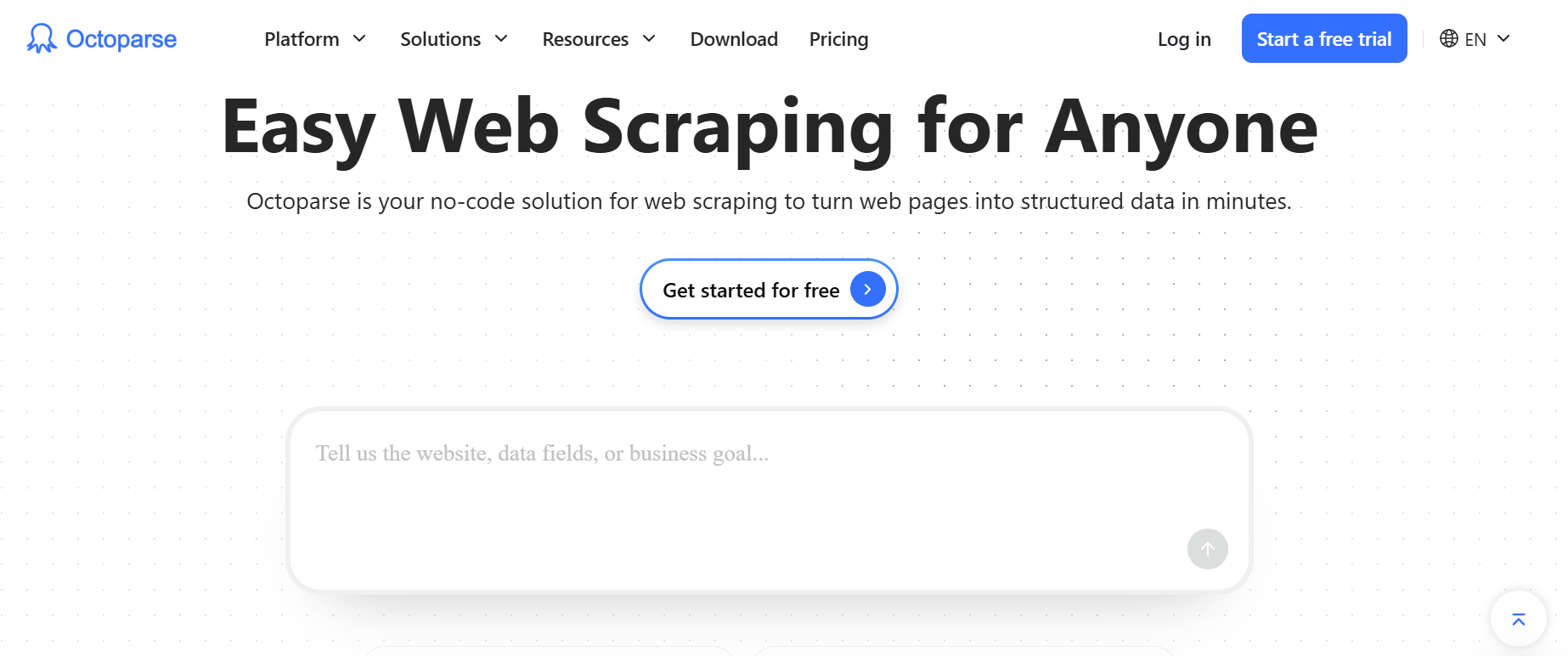
Constraint-based thinking changes the recommendation entirely when the real bottleneck is not API design but technical skill. Octoparse is a no-code, visual scraping builder with a Free plan covering 50,000-row monthly exports and paid tiers starting at $69 per month. It is built around a template marketplace for common, well-structured sites.
For teams where analysts or marketers collect data rather than engineers, removing the API-integration step isn't a nice-to-have. It is the difference between the tool getting used and the tool sitting unused.
No-Code Scraping for Faster Trend Discovery
Most content creators already live this reality. When the goal is tracking trending topics, monitoring competitor content, or sourcing viral clip ideas at scale, the technical barrier of a scraping API is often what stops the process entirely.
Teams using a clip creator tool to produce short-form video at speed need trend signals fast, and a no-code scraping option like Octoparse lets non-technical creators pull structured data from relevant sources without waiting on a developer to build the pipeline.
6. ScrapeBadger
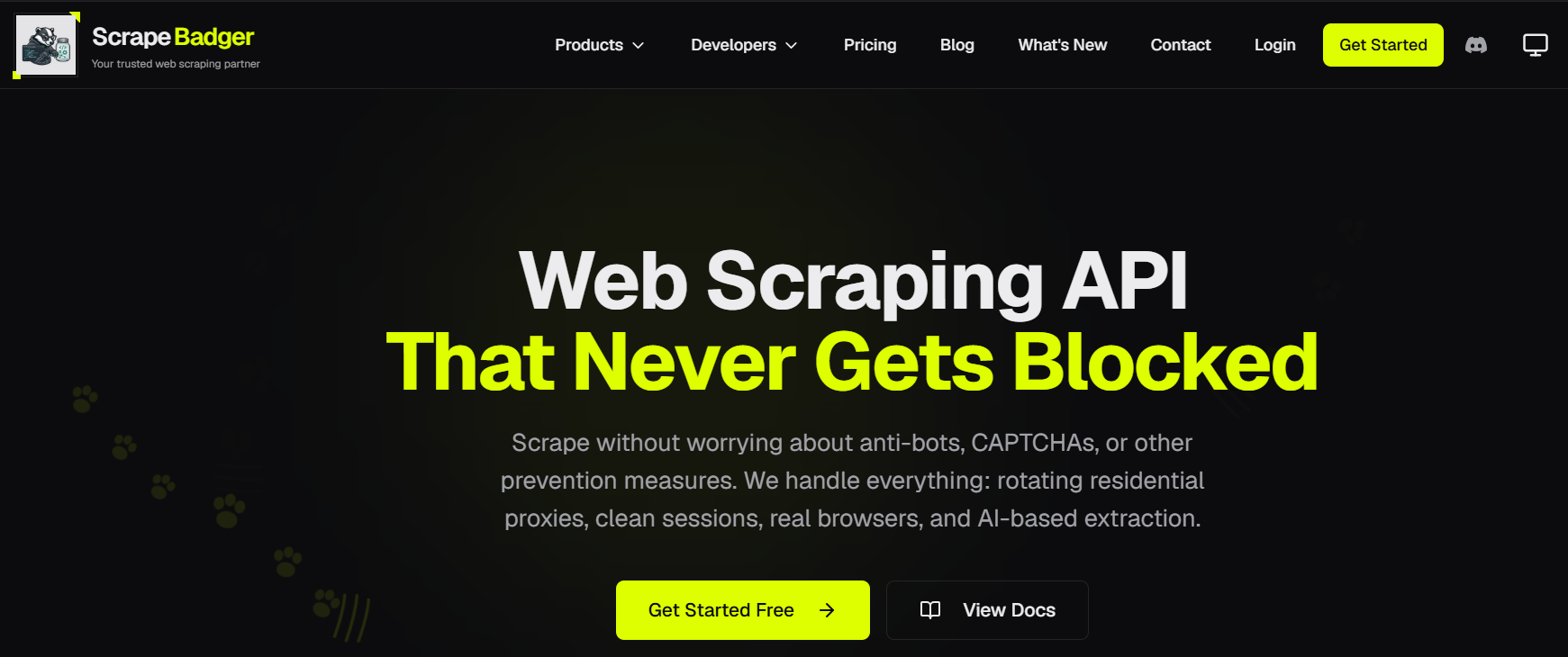
Some gaps are not about pricing or speed. They are about category coverage. ScrapingBee has no native endpoints for Twitter/X, Reddit, TikTok, or YouTube, which means any team trying to monitor social signals through ScrapingBee is already working around a structural limitation, not just a pricing one.
ScrapeBadger covers those platforms directly, along with LinkedIn, Amazon, eBay, Zillow, and 40-plus additional sources. Credits never expire, and a built-in MCP server supports AI agent workflows. That last detail matters for teams building automated content pipelines, not one-off data pulls.
7. Bright Data
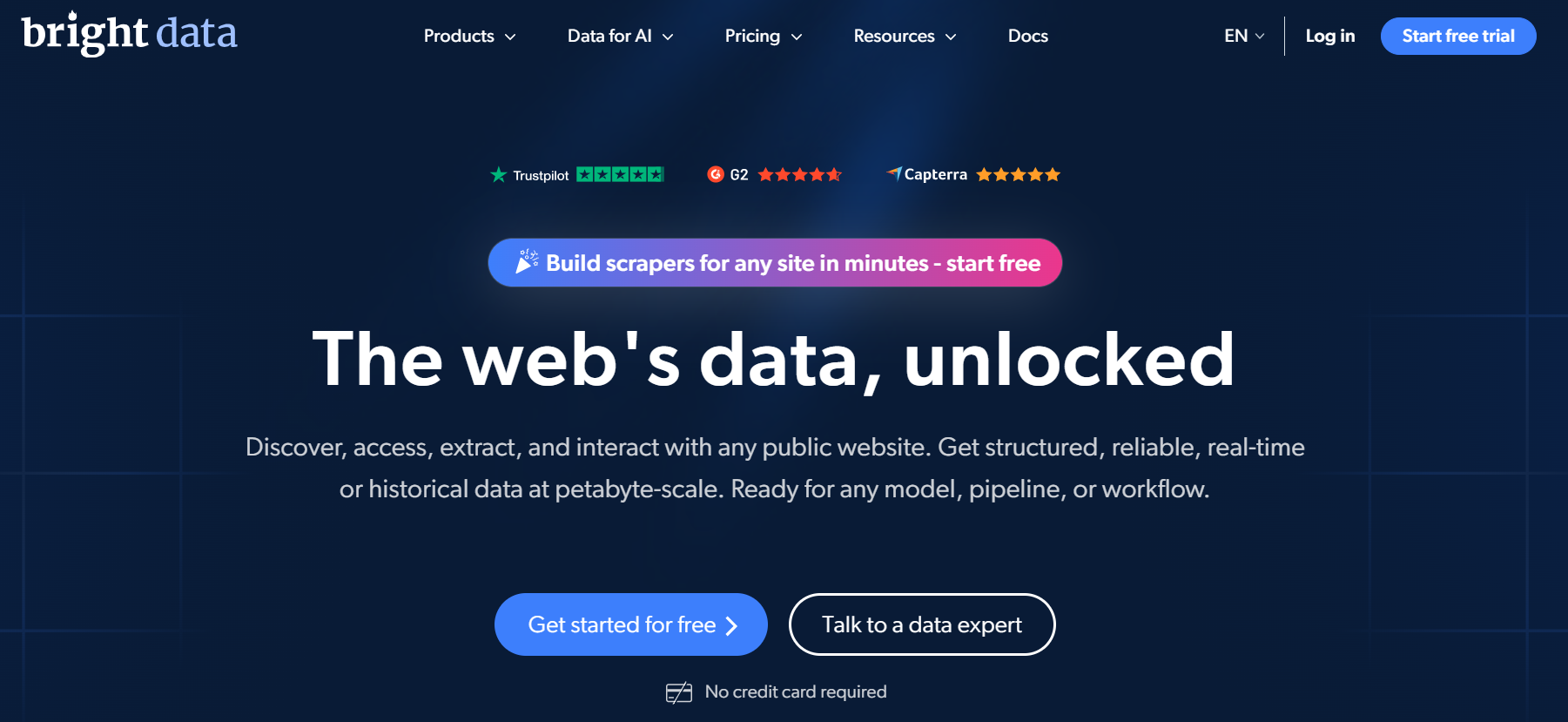
When volume and operational complexity outgrow what a single-endpoint API can handle, the category shifts from scraping tool to infrastructure. Bright Data sits in that second category, combining a Web Scraper API with proxy products, a scraping browser, structured datasets, and an in-browser IDE inside one ecosystem.
The tradeoff is real: more capability means more configuration, more pricing complexity, and a steeper learning curve. For teams whose actual constraint is geo coverage, enterprise compliance requirements, or multi-product data operations, that tradeoff is worth it. For teams whose constraint is simply cost or reliability, it is probably more platform than the problem requires.
Why the Match Matters More Than the Ranking
A ranked list implies one winner. The reality is that the right alternative depends entirely on which specific gap is costing you the most right now. A team burning credits on failed requests needs Zyte. A team locked out of social media data needs ScrapeBadger. A team that wants the same developer experience with better economics needs ScraperAPI. Treating these as interchangeable options is how teams end up switching twice.
Knowing which gap you have is the prerequisite. And that turns out to be a more interesting problem than it first appears.
The 30-Minute Workflow to Choose a ScrapingBee Alternative

First, diagnose which gap applies to your pipeline. The workflow below turns that diagnosis into a structured 30-minute process, separating confirmation from assumption so any migration you make actually solves a real, verified problem.
Minute 0-10: Test Your Real Targets Against the Credit Multiplier
Start with your actual target sites, not sample URLs from a documentation page. Run a small, representative job through ScrapingBee's free plan, which includes 1,000 API credits according to the Firecrawl Blog, and record exactly how many credits each request consumes once JavaScript rendering, premium proxies, or stealth mode activates. That number is your real effective cost per request, and it will almost certainly differ from what the headline credit count implies.
The failure point is usually here. Teams skip this step, extrapolate from the pricing page, and discover the gap only after committing to a full migration.
Minutes 10-15: Check Your Success Rate Against the Benchmark
Run the test job and compare your observed success rate against the independently benchmarked 84.47% figure. The question is not whether ScrapingBee underperforms in general. The question is whether it underperforms on your specific targets. Some sites trigger stealth mode consistently. Others render cleanly on standard JavaScript calls. The benchmark tells you what to expect on average; your test tells you what actually happens on the URLs your pipeline depends on.
If your success rate tracks close to the benchmark, reliability is probably not your gap. If it falls meaningfully below, that confirmation matters before you evaluate a single alternative.
Minutes 15-20: Match One or Two Alternatives to Your Confirmed Gap
The pattern that surfaces repeatedly across scraping tool evaluations is this: teams pick alternatives by reputation rather than by documented capability fit. A team burning credits on JavaScript rendering needs a different solution than a team locked out of social media endpoints. Use the alternatives covered earlier in this post to match one or two candidates to whichever specific gap showed up in the first two steps.
According to the ScrapingBee Blog, a single API call handles JavaScript rendering, proxy rotation, and CAPTCHA solving, which means the credit multiplier compounds quickly when all three activate together. Knowing which of those three is driving your cost gives you a precise filter for which alternative to test next.
Minutes 20-30: Run a Direct, Apples-to-Apples Comparison
Take the same representative job from the first step and run it through your matched alternative's free tier or trial. Compare both cost per successful request and success rate against your ScrapingBee results from the same targets. This is the only comparison that confirms whether the alternative resolves the specific gap you identified, not just whether it looks better on a pricing page.
This step is the critical difference between a useful migration and a lateral move. Without running the same targets through both tools, you are comparing marketing copy to marketing copy.
Simplifying the Content Creation Stack
Most content creators who rely on web scraping to surface trending topics or viral clip ideas face a version of this same problem: they assemble several tools, each solving one piece of the puzzle, and spend more time managing the stack than acting on what it finds. Crayo takes a different approach, consolidating the workflow so creators move from raw idea to finished short-form video without switching contexts between tools.
Why This Order Matters
The sequence is deliberate. Testing real targets first prevents you from choosing an alternative based on a gap that doesn't actually exist in your pipeline. Checking success rate second prevents you from attributing a reliability problem to cost, or vice versa. Matching to a specific documented strength third prevents you from evaluating five alternatives when one is clearly the right fit. Testing head-to-head last prevents you from migrating based on assumption rather than confirmed evidence.
Skipping any step in this order tends to produce the same outcome: a migration that solves a different problem than the one you actually had.
Before vs. After: What Changes
Before this workflow: the typical pattern is evaluating alternatives by general reputation, migrating a pipeline, and discovering the same credit unpredictability or reliability issue under a new platform name. The problem was never a shortage of options. It was picking without confirming which specific, documented limitation applied to the actual targets and usage pattern in question.
After this workflow: you have real targets tested against the actual credit multiplier, a success rate compared against an independent benchmark, a matched alternative tested head-to-head, and the original gap confirmed resolved before full migration. The improvement does not come from finding a universally better scraping platform. It comes from confirming which specific limitation actually applies before switching.
Once you have clean, structured data flowing from the right tool, the next challenge is one most teams underestimate until they are already buried in it.
Related Reading
- Tiktok Content Strategy
- Sludge Content
- What Is Brainrot Content
- How To Do Text To Speech On Tiktok
- How To Make Brainrot Videos
- Long Form Video Content
- What Is Italian Brainrot
- Tiktok Retention Rate
- How To Create Pov Videos
- Italian Brainrot Quiz
- How To Make Tiktok Videos More Engaging
Speed Through Simplified Content Workflows With Crayo
If you create short-form content and want to apply this same speed principle to finding trending clip ideas at scale, a clip creator tool handles the video side of that workflow, generating AI voiceovers, subtitles, and optimized footage without requiring separate tools or technical setup. The teams moving fastest pair the right data pipeline with fast analysis on landing, not treating either step as optional.