
Have you ever watched a TikTok video, blinked, and suddenly lost an hour of your day? That is TikTok brain rot in action, and it happens because certain creators know exactly how to hold your attention from the first second to the last. TikTok retention rate, which measures how long viewers actually watch your video before scrolling away, is the single biggest factor separating creators who grow from those who stay stuck. If you want more watch time, better average view duration, and a stronger completion rate, this article breaks down 7 practical ways to get there in 30 minutes or less.
Getting your retention rate up does not have to feel like guesswork. Crayo's clip creator tool helps you build short-form videos that are structured to keep viewers watching, with features that make it easy to nail your hook, pacing, and video length without spending hours editing. Whether you are chasing a higher audience retention %age or trying to push your content into the TikTok algorithm's good graces, Crayo gives you a faster, cleaner path to videos that people actually finish watching.
Table of Contents
- Why Creators Struggle to Improve Their TikTok Retention Rate
- The Hidden Cost of Chasing a Flat Retention Benchmark
- 7 Ways to Increase TikTok Retention Rate in 30 Minutes
- The 20-Minute Workflow to Improve TikTok Retention
- Improve Retention Faster With Crayo
Summary
- Retention benchmarks shift significantly based on video length, and most creators apply the wrong standard across all their content. Data from Retensis in 2026 shows completion rate targets vary from 60 to 70% for videos under 15 seconds, dropping to 40 to 50% for videos between 30 and 60 seconds. A creator grading a 45-second video against a 70 % target is comparing it to a standard built for content three times shorter, which produces consistently wrong conclusions about what is and is not working.
- The first three seconds of a video carry more weight than any other editing decision. Research from Opus Pro found that retention drops by up to 40 % if the opening fails to hook viewers, meaning nearly half the audience can disappear before the core idea even begins. A hook that identifies a specific problem or creates an unresolved question outperforms a general introduction in nearly every format.
- Curiosity gaps function as structural retention tools, not stylistic choices. When a video withholds the full answer and signals that the most useful information is still coming, viewers delay scrolling to collect on that implied promise. That accumulated delay across a video is the mechanical difference between a 35% completion rate and a 65% one.
- Editing by subtraction drives retention more reliably than adding effects or transitions. Every unnecessary pause, repeated point, or overexplained concept gives viewers a window to leave. Socialync's 2026 data places the viral push eligibility threshold at a 70 % completion rate, and removing low-value seconds is one of the most direct paths toward that number.
- Changing one variable at a time is the only way to learn what actually moved the needle. Creators who simultaneously adjust the hook, pacing, visuals, and captions after a weak video have no way to identify which change produced the result. Isolating one element per upload, then reading average watch time, completion rate, and retention drop points together, turns content decisions into a repeatable diagnostic rather than a guessing process.
- A 5% improvement in retention can increase profits by up to 95% according to research from Propel, which means the compounding effect of small, accurate measurement corrections is far larger than it appears from any single video. Visibility without calibration, knowing the percentage but using the wrong benchmark to interpret it, produces confidence without accuracy, and that combination leads content strategy in the wrong direction over time.
Crayo's clip creator tool addresses this by combining AI voiceovers, synced subtitles, and optimized footage into one workflow, so the retention fixes a creator diagnoses from their analytics can be built and published quickly rather than sitting as notes waiting for a future re-shoot.
Why Creators Struggle to Improve Their TikTok Retention Rate
Most creators trying to improve their TikTok retention rate are solving the wrong problem. They assume the issue is content quality, posting frequency, or topic selection, when the actual bottleneck is simpler and easier to fix: they are measuring performance against a benchmark that was never built for their specific video length. The benchmark problem is more consequential than it sounds. According to Fanpage Karma's 2025 TikTok algorithm insights, TikTok videos with a watch-through rate above 50% are significantly more likely to be distributed by the algorithm, but that 50% figure is not a universal ceiling to clear. It is a floor, and only for certain video lengths. Industry benchmarking from Socialync in 2026 places the completion rate target for viral distribution closer to 70%, meaning creators still optimizing for 2024 standards are setting the bar a full 20 points too low.
Where the Measurement Breaks Down
The failure point is usually a single flat number applied to every video regardless of runtime. Benchmark data from Retensis in 2026 shows completion rate targets shift dramatically by length:
- 60 to 70% for videos under 15 seconds
- 50 to 60% for 15 to 30 seconds
- 40 to 50% for 30 to 60 seconds
A creator holding a 45-second video to a 70% completion standard is comparing it against a target built for content that is three times shorter. The video looks like it failed. It may have actually performed well.
Views vs. Retention: Engineering Content Over Guesswork
Most creators handle this by checking view count and drawing conclusions from there. It feels logical because views are visible and immediate, but views tell you nothing about where attention collapsed. Two videos can share the same view count while one holds 65% completion and the other drops to 22% by the midpoint.
- The creator who never opens TikTok Studio's retention graph treats both as equivalent.
- The creator who does sees exactly which second lost the audience and edits that moment out of the next attempt.
One is guessing. The other is engineering.
Baking Retention into High-Volume Workflows
Creators scaling their output face a compounding version of this problem. When you are posting daily or building a clipping operation across multiple formats, manually diagnosing retention graphs for every video becomes a real-time cost. Crayo's clip creator tool is built for exactly this scenario, structuring hooks, pacing, and video length into the editing process itself so that retention optimization is baked in from the start rather than diagnosed after the fact.
Matching Pacing Rhythms to Content Format
The deeper issue is that pacing rarely gets matched to format. According to the OpusClip Blog's 2024 research on TikTok length and retention, retention is the single most important metric for algorithmic success on TikTok, yet most creators keep the same pacing rhythm across a 9-second clip and a 55-second video. Those two formats have entirely different audience tolerance curves. When pacing stays flat across formats, retention stays inconsistent, and inconsistency makes it nearly impossible to identify what is actually working. What happens when you finally apply the right benchmark to the right video length might surprise you more than the numbers themselves.
Related Reading
- Short Form Content Ideas
- Short Social Media Videos
- How To Make Videos For Social Media
- How To Increase Video Engagement
- Video Storytelling
- Social Media Content Ideas
- Emotional Hooks
- How To Get More Comments On Youtube
- YouTube Average View Duration
- Why Are My Tiktok Videos Not Getting Views
The Hidden Cost of Chasing a Flat Retention Benchmark
Most creators who apply a single flat benchmark across all their videos aren't making a careless mistake. They're following advice that was reasonable two years ago and hasn't been updated since. The problem isn't ignorance. It's that an outdated number, applied consistently, produces consistently wrong conclusions. The failure point is usually invisible until you look at what decisions get made downstream. When a 45-second video hits 42% completion, and you're measuring it against a flat 50% target, you call it a loss. You scrap the topic, change the pacing, maybe abandon the format entirely. But Retensis's 2026 benchmark data shows 40-50% is the correct target range for that runtime. That video didn't underperform. You just graded it on the wrong curve, and the lesson you drew from it was wrong.
The Compounding Risk of Misread Benchmarks
That misjudgment compounds fast when you're producing volume. The same issue surfaces in gaming clips and commentary content alike: creators abandon topics that were actually connecting, because the number looked bad against the wrong standard. They repeat formats that genuinely underperformed, because those happened to hit 50% and felt like wins. Over time, the content strategy drifts in the wrong direction, not from bad instincts, but from a measurement error that never got corrected. According to research from Propel, a 5% boost in retention increases profits by up to 95%, which means even marginal improvements in how accurately you measure and respond to retention data carry real compounding weight.
Balancing Workflow Scale With Diagnostic Precision
Most creators handle this by checking the percentage, comparing it to whatever benchmark they absorbed from creator advice content, and moving on. That process feels efficient. The hidden cost is that it optimizes for speed of judgment, not accuracy. When you're scaling output and making ten content decisions a week based on that process, the errors don't cancel out. They stack. Tools like Crayo are built around the idea that going viral is repeatable and systematic, not accidental, which means the editing workflow itself can be standardized while the analytical layer stays sharp. Getting the benchmark right is what makes the system actually work.
The Danger of Uncalibrated Metric Visibility
The parallel worth noting here connects to a broader measurement problem. CustomerGauge's 2025 industry analysis found that 44% of businesses don't calculate their customer retention rate at all, meaning nearly half operate without the metric they claim to care about.
TikTok creators have the opposite problem: the metric is visible and easy to find, but the reference point used to interpret it is wrong. Visibility without calibration produces confidence without accuracy. That combination is more dangerous than simply not measuring.
How Misinterpreted Data Derails Strategy
The real cost of a flat benchmark isn't one misread video. It's the pattern of decisions built on top of that misread, week after week, until the content strategy reflects a fiction instead of what the audience actually responded to. What happens when you finally replace that flat number with a structured, length-specific approach might take less than half an hour to implement.
Related Reading
- How To Do Text To Speech On Tiktok
- What Is Brainrot Content
- What Is Italian Brainrot
- How To Make Tiktok Videos More Engaging
- Italian Brainrot Quiz
- How To Make Brainrot Videos
- How To Create Pov Videos
- Long Form Video Content
- Tiktok Content Strategy
- Sludge Content
7 Ways to Increase TikTok Retention Rate in 30 Minutes

Increasing your TikTok retention rate is not about making longer videos. It is about removing the moments that cause viewers to lose interest and strengthening the parts that make them continue watching. The goal is not simply to keep people on the video for a few extra seconds. The goal is to create a clear viewing experience where the hook, pacing, visuals, and payoff work together from beginning to end.
1. Strengthen the First Three Seconds
Many TikTok videos open with long greetings, unnecessary context, or vague statements that give viewers no reason to stay. Retention drops by up to 40% if the first three seconds fail to hook viewers. That is not a small margin. That is nearly half your audience gone before your idea even starts. The fix is structural, not stylistic.
- Open with a surprising result
- A specific problem
- An unfinished thought your audience immediately recognizes
Instead of "Today I want to explain how to improve TikTok retention," say "If viewers leave after three seconds, this opening mistake may be why." The second version identifies a problem and creates curiosity about the answer, all in one sentence.
2. Focus Each Video on One Main Idea
The failure point is usually overreach. A video covering hooks, hashtags, posting times, captions, and monetization in sixty seconds is not a video. It is a list that nobody finishes. One audience, one problem, one lesson, one desired action. That constraint is not a limitation. It is the entire strategy. One clear idea reduces the mental effort required to follow the video. When viewers do not have to work hard to understand what is happening, they stay. When they have to keep track of five separate threads, they scroll.
3. Create Curiosity Gaps Throughout the Video
The same issue surfaces in long-form content and short-form clips alike: revealing the complete answer at the beginning removes the viewer's reason to continue watching. Curiosity gaps are not manipulation. They are structure. Each point should naturally lead to the next useful point, so the viewer always feels like the best part is still coming. Phrases like "the most important fix comes next" or "here is what most creators completely miss" work because they create a small promise. The viewer delays scrolling to collect on it. That delay is watch time. Accumulated across a video, those small delays are the difference between a 35% completion rate and a 65% one.
4. Remove Pauses, Repetition, and Filler
Review every sentence and scene with one question: does this add value, increase curiosity, or move the video forward? If it does none of those things, cut it. Repeated hooks, slow transitions, and overexplained simple points are not neutral. They actively cost you, viewers. Tighter editing keeps the video moving and closes the windows where attention drifts. Most creators treat editing as a technical step. The creators with strong average watch time treat it as the primary retention tool.
5. Change the Visual Experience Regularly
Static visuals make a video predictable, and predictability invites scrolling. Purposeful visual changes, including captions, B-roll, screen recordings, close-ups, and camera-angle shifts, refresh attention without cluttering the message. The visual should support what the viewer is hearing, not compete with it. Many creators handle this manually, cutting between clips and layering captions frame by frame. Crayo collapses that process by generating AI voiceovers, styled subtitles, and optimized footage together, so the visual rhythm that holds attention is built into the output from the start rather than assembled one element at a time.
6. Build Toward a Clear Payoff
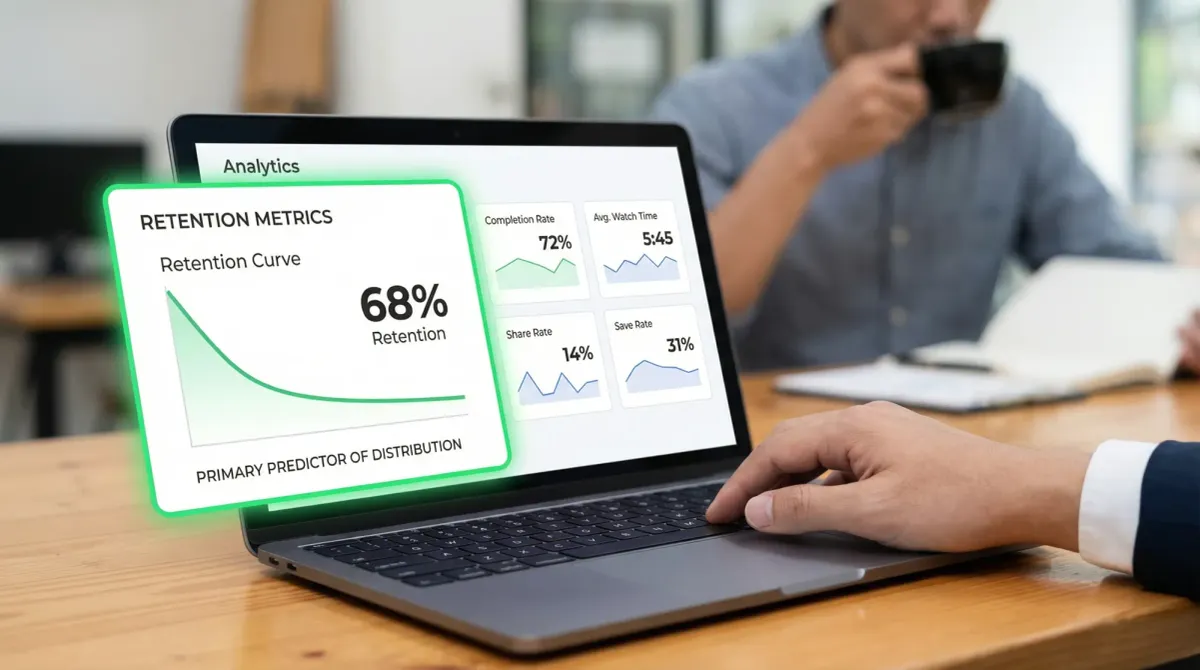
A strong hook with a weak ending is worse than no hook at all. It feels like a broken promise. If the hook promises the reason viewers leave after three seconds, the ending must clearly identify that mistake and explain what to do differently. The payoff is what earns the rewatch, the share, and the save. Completion rate and rewatch behavior are the signals that tell you whether your payoff landed. Views tell you who showed up. Completion rate tells you who stayed. Rewatches tell you who found it worth a second look. Those are the numbers that matter.
7. Use Retention Data to Improve One Element at a Time
A common pattern is this: a creator sees low performance, changes the hook, the pacing, the visuals, and the caption all at once, and then has no idea which change moved the needle. Improving one element per video is slower to describe but faster to learn from. When you change only the hook and completion rate rises, you know exactly why. Review average watch time, completion rate, retention drop points, rewatches, shares, and saves. Then pick one variable.
- If viewers leave immediately, the hook needs work.
- If they leave at the midpoint, the pacing is losing them.
- If they reach the end but do not engage, the payoff or call to action is not strong enough.
That sequence is a repeatable diagnostic, not a guessing game.
Contextualizing Retention Across Content Lengths
Videos under 15 seconds carry a 90% average completion rate on TikTok. That number is not an argument for making every video short. It is a reminder that format and length shape what a realistic completion target looks like, and that data only becomes useful when you read it in context. The difference between creators who improve steadily and those who plateau is not talent or posting frequency. It is whether they treat retention as a system with identifiable levers, or as a mystery that resolves itself when the algorithm decides to cooperate. What happens when you compress all seven of these strategies into a single repeatable workflow might take less time than you expect.
The 20-Minute Workflow to Improve TikTok Retention

Treating retention as a system means nothing if your production process works against you. Most creators understand the levers now. The gap is execution speed. The failure point is usually fragmentation. When researching, scripting, recording, editing, and analyzing all happen simultaneously, each stage competes for attention, and none gets done well. The workflow below separates those stages so your brain handles one problem at a time, and every decision moves toward a single outcome: keeping viewers watching longer.
Minute 0-5: Define One Viewer Problem
Before writing a single word, lock in four things:
- Your audience
- The one problem they recognize
- The solution you will deliver
- The single takeaway they will carry out
Not five takeaways. One.
The constraint matters more than it sounds. A video built around one clear problem gives viewers a reason to stay because they can see exactly where the video is going. The moment a video tries to solve three things, viewers sense the drift and leave. Specificity is what holds attention, not volume of information.
Minutes 5-10: Write a Script That Withholds Just Enough
The structure is simple:
- Hook
- Problem
- Solution
- Payoff
- Call to action
What separates a high-retention script from a flat one is not the structure itself but how information is released across it.
Building Curiosity and Momentum in Scripting
Instead of opening with "Here are seven ways to improve your retention rate," open with the first problem and a hint that more is coming. That gap between what viewers know and what they want to know is what keeps the watch time climbing. According to Clixie AI, videos with strong hooks in the first 3 seconds see up to 40% higher retention rates, which means the script's opening line carries more weight than any other editing decision you will make. Each section of the script should give viewers a reason to reach the next one. Think of it as a chain where every link earns the next. If any section of your script delivers its full value immediately, with nothing left to discover, viewers have permission to leave.
Minutes 10-15: Build the Video Around Visual Change
- Record or generate your narration
- Captions
- B-roll
- Supporting visuals
As you build, apply one rule: change something on screen every few seconds. A caption shift, a graphic, a cut to a new angle, a demonstration. Not for style, but because visual consistency signals to the brain that nothing new is coming.
Efficiency Through Streamlined Workflows
The goal is not to overwhelm viewers with effects. It is to give the eye a reason to stay curious while the narration carries the argument forward. Visual variety and narrative clarity work together. One without the other either distracts or bores. Most creators who handle this manually spend the bulk of their time here, sourcing B-roll, timing captions, and syncing audio. That time cost compounds across every video. Crayo addresses this directly by generating AI voiceovers, synced subtitles, and optimized footage in a single workflow, collapsing what typically takes an hour into minutes without requiring technical editing expertise.
Minutes 15-20: Edit by Subtraction
The edit is where retention is won or lost, and the instinct most creators get wrong is addition. They add music, add effects, add transitions. The better move is removal.
- Cut unnecessary pauses.
- Remove any scene that repeats a point already made.
- Shorten any explanation that takes fifteen seconds when eight will do.
If two scenes communicate the same idea, keep the stronger one and delete the other. A tighter video does not feel shorter to viewers. It feels faster, and faster feels more valuable. Socialync reports that a 70% completion rate is the threshold TikTok uses to determine viral push eligibility in 2026. Editing by subtraction is one of the most direct ways to move a video toward that number, because every second of unnecessary content is a second where a viewer can decide to leave.
Minutes 20-30: Publish, Then Read the Data With Intention
Before publishing, do one final check:
- Opening hook
- Caption clarity
- Pacing
- Visual flow
- Ending
Then publish and step away. Analytics need volume before they mean anything, so resist the urge to check numbers within the first hour.
Decoding Performance Signals
When enough data exists:
- Review average watch time
- Completion rate
- The retention graph shape
- Rewatches
- Shares
- Saves together
A video with strong shares but low completion tells a different story than one with high rewatches and average watch time. Each combination points to a different fix. The pattern to look for is consistency. If videos with bold opening statements consistently hold viewers longer than videos with soft introductions, that is a signal, not a coincidence. Double down on what the data confirms rather than rebuilding your entire approach after one underperformer.
Why Separation Is the Real Strategy
The workflow works not because the individual steps are new, but because separating them removes the cognitive load that kills execution. When planning, scripting, recording, editing, and analyzing each have a defined window, you stop making production decisions and creative decisions at the same time. That separation is what allows every stage to have one clear objective.
- Plan around one problem.
- Script for curiosity.
- Build for visual change.
- Edit by subtraction.
- Publish and learn.
Five stages, five objectives, no overlap.
Breaking the Production Ceiling
The challenge that remains for most creators is that even a well-structured workflow takes time to execute manually at scale. Researching ideas, writing scripts, generating captions, producing footage, and reviewing analytics across multiple videos per week creates a production ceiling that discipline alone cannot lift. What happens when that ceiling meets a tool designed to remove it is worth understanding before your next upload.
Improve Retention Faster With Crayo
The production ceiling mentioned earlier is real, but it lifts faster than most creators expect once diagnosis replaces guessing. Open Crayo, paste your current script, and generate a front-loaded rewrite targeting the specific second your retention graph shows viewers dropping. That precision matters because rewriting a five-second hook takes minutes in Crayo rather than a full re-shoot, which means you can test a revised opening on your next upload instead of your next month.
Creators scaling short-form output consistently find that the bottleneck is never the idea. It is the gap between knowing what the retention graph shows and having a polished, publish-ready version fast enough to act on it. Crayo closes that gap by combining AI voiceovers, subtitles, and optimized footage into one workflow, so the fix you diagnose today becomes the video you publish tomorrow.
Related Reading
• YouTube Hooks
• Social Media Hooks
• How To Make A Good Hook
• Scroll Stopping Hooks
• Best Video Format For Tiktok
• Pov Ideas For Tiktok
• Brainrot Examples
• Best Tiktok Hooks
• Viral Hooks For Instagram