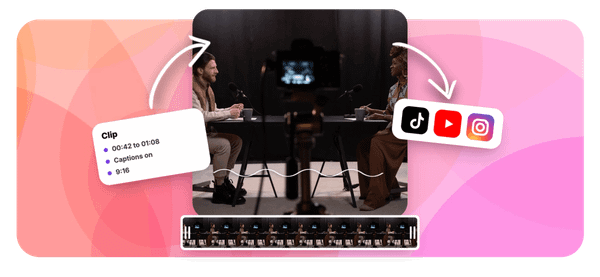


You record a great podcast episode, but it sits behind a paywall or as a lengthy audio file that most people never find. Meanwhile, short video clips get thousands of views on Instagram, TikTok, and LinkedIn every day. Turning your podcast into shareable social media clips is one of the fastest ways to grow your audience, and this article walks you through exactly how to post podcast clips on social media in 30 minutes or less, without wasting hours on editing.
That kind of speed is possible with the right tools, and that is where Crayo's clip creator tool comes in. Paired with the best AI podcast clip generator features on the market, Crayo helps you pull the strongest moments from your episodes, add captions, and format clips for each platform automatically. Less time cutting and trimming means more time actually connecting with your audience.
Table of Contents
- Why Podcasters Struggle to Get Results From Clip Posting
- The Hidden Cost of Treating TikTok and Shorts as Interchangeable
- How to Post Podcast Clips on Social Media in 30 Minutes
- The 30-Minute Workflow to Post Podcast Clips Across Platforms
- Produce Platform-Specific Clips Faster With Crayo
Summary
- Consistent posting doesn't guarantee audience growth, and the data makes that gap clear. According to a 2026 LinkedIn analysis by Juno Colter, 78% of podcasters post content consistently, yet only 12% see meaningful audience growth. The difference between those two groups is almost never content quality. It is whether the clips are built for the platform receiving them.
- TikTok and YouTube Shorts run on fundamentally different algorithmic logic, even though they look nearly identical on the surface. TikTok uses an aggressive cold-start model that tests content against audiences who have never heard of the creator, regardless of follower count. Shorts, by contrast, rewards channel-level watch time and favors content that pulls viewers toward full episodes on the same channel.
- Volume strategy compounds differently on each platform, and applying the same approach to both produces the worst outcome on each. TikTok rewards higher clip volume distributed across multiple accounts because each post gets an independent algorithmic test. Shorts rewards concentrated posting to a single channel because watch-time signals accumulate at the channel level.
- Metric selection determines whether you can diagnose what is and isn't working. A TikTok clip with 40,000 views and zero follower growth is underperforming, while a Shorts clip with 8,000 views and a 12% subscriber conversion rate is working as intended. Collapsing both into a single view-count dashboard hides the signal entirely. TikTok performance is best measured by per-account median views, follower growth rate, and off-platform click-throughs.
- Sequencing decisions within a production workflow matter as much as the decisions themselves. Sorting clips by platform fit before writing captions prevents the common mistake of assuming a caption change alters what the algorithm actually measures. According to Social Realtr's 30-minute video workflow guide, you can create a full month of content in under an hour when you make sorting and distribution decisions before opening the publishing interface.
- Caption quality functions as a conversion variable across all short-form platforms, not just an accessibility consideration. Cleanvoice AI's research notes that 85% of Facebook video is watched without sound, and similar behavior patterns hold across TikTok and Shorts. Clips with clear, well-formatted captions retain viewers who would otherwise drop off in the first few seconds, directly affecting the algorithmic signals each platform uses to decide whether to keep distributing the content.
Crayo's clip creator tool addresses the production bottleneck that makes platform-specific strategies collapse by automating clip generation, caption styling, and subtitle formatting so building two distinct clip versions doesn't require twice the editing time.
Why Podcasters Struggle to Get Results From Clip Posting

Posting podcast clips consistently and still watching the numbers flatline is one of the more demoralizing experiences in content creation. The effort is real, the output is visible, but growth simply doesn't follow. According to Juno Colter's 2026 LinkedIn analysis, 78% of podcasters post content consistently, yet only 12% see meaningful audience growth. Consistency, it turns out, isn't the same as strategy.
Algorithmic Differences Across Platforms
The failure point is usually invisible to the person experiencing it. Most podcasters assume the clip itself is the problem, so they tweak the hook, shorten the runtime, or switch topics. What they rarely examine is whether the clip was built for the platform it landed on. TikTok and YouTube Shorts look nearly identical on the surface:
- Vertical video
- Similar length
- Comparable editing style
But they run on fundamentally different algorithmic logic. TikTok runs what a documented 2026 analysis describes as the most aggressive cold-start algorithm in mainstream short-form video, testing your clip on a fresh audience regardless of your follower count. Shorts, by contrast, rewards channel-level watch time and pulls viewers toward your full episodes on the same channel.
Tailoring Distribution Volume
The same issue surfaces with volume and account strategy. Podcasters who push the same clip to both platforms at the same frequency are essentially using a fishing rod when one body of water calls for a net and the other calls for a single well-placed line. Documented guidance recommends 30 to 50 candidate clips per episode, distributed at higher volume across multiple TikTok accounts for reach, and at lower, more concentrated volume on the official podcast channel for Shorts. That distinction alone changes what success looks like on each platform.
Strategy Over Pure Output
Most teams handle clip distribution by exporting one finished video and scheduling it everywhere at once, because it feels efficient. The hidden cost is that neither platform gets what it actually rewards, and the creator ends up measuring both by raw view count, which tells them almost nothing useful. Podcasters posting 5 to 7 times per week with no platform-specific strategy see only a 3% conversion rate. Volume without alignment is just noise. Tools like Crayo's clip creator address part of this by automating the clip generation process itself, pulling strong moments, adding captions, and formatting for each platform, so the time saved on production can be redirected toward building the right distribution logic for each destination.
Platform-Specific Success Metrics
The metric problem runs deeper than most podcasters realize. Tracking overall views across TikTok and Shorts as a single number hides whether either strategy is working. TikTok performance should be measured by per-account median view count, follower growth rate, and click-throughs to a landing page. Measure Shorts performance by channel subscriber growth and full-episode watch time on that same channel. When those two data streams get collapsed into one dashboard, the signal disappears entirely. What makes this particularly frustrating is that the underlying podcast content is rarely the real obstacle.
Related Reading
- Best AI Podcast Clip Generator
- What Is An Audiogram Podcast
- How Long Does It Take To Trim A Zoom Recording
- Content Repurposing Examples
- Webinar To Short Clips AI
- Podcast Clips For Social Media
- Video Clipping For Social Media
- Repurpose Webinar Content
- Can You Trim The Middle Of A Zoom Recording
- How Do I Repurpose My Interview To Social Media
- Sermon Clips AI
The Hidden Cost of Treating TikTok and Shorts as Interchangeable
Treating TikTok and YouTube Shorts as the same distribution channel creates more than measurement confusion. It actively bleeds growth from both sides because each platform's algorithm punishes content built for the other's logic. The pattern surfaces consistently across podcast clip strategies: a creator optimizes for TikTok's cold-start discovery model, then posts the same clip to Shorts expecting similar reach. What they get instead is a clip that drives standalone views but fails to pull subscribers back to the full episode on their channel. Shorts' algorithm reads that as low conversion value and deprioritizes the content. The clip wasn't bad. It was built for the wrong reward signal.
Where the Real Production Cost Hides
The failure point is rarely content quality. It's the assumption that one editing decision serves both platforms. A clip cut for maximum shareability on TikTok, with a self-contained hook and no clear path back to the channel, actively works against Shorts' documented preference for content that drives full-episode watch time on the same channel. When you build one clip and post it everywhere, you're not saving time. You're splitting your results in half and blaming the wrong cause.
Platform-Specific Clip Customization
Most podcast clippers handle this by editing a single version and adjusting the caption or call-to-action slightly between platforms. That feels efficient. But caption changes don't alter what the algorithm measures.
- Shorts tracks whether viewers migrate to long-form content on your channel.
- TikTok tracks whether new accounts are finding your content cold.
A caption swap doesn't change either signal. Crayo addresses this at the production layer, letting creators generate platform-specific clip variations quickly enough that building two distinct versions doesn't take twice as long.
Why Volume Strategy Compounds the Problem
When the same clip goes to both platforms at the same posting frequency, the volume math breaks down in opposite directions.
- TikTok's cold-start testing rewards higher clip volume across multiple accounts because each post gets an independent algorithmic test.
- Shorts rewards concentrated posting to a single channel because watch-time signals accumulate at the channel level, not the clip level.
Spreading Shorts content thin across accounts dilutes the very metric the platform uses to decide what to amplify.
The Compounding Cost of Misalignment
The compounding effect is what most podcasters miss: a unified strategy doesn't just underperform on both platforms. It actively prevents either platform's documented advantage from building momentum over time, because the signals each algorithm needs never reach the threshold where amplification kicks in. And once you understand exactly what each platform needs from your clips, the next question becomes surprisingly practical.
Related Reading
- Podcast Shorts
- Repurpose Keynote Into Social Media Clips
- Church Reels Editing
- How To Start Clipping On Instagram
- How To Trim A Zoom Recording Saved On My Computer
- Best Video Clipping Tool For YouTube
- Repurposing Content For Social Media
- How To Add Audio To A Video
- Podcast Reels
- How To Repurpose Webinar Content For Marketing
How to Post Podcast Clips on Social Media in 30 Minutes
Treating TikTok and YouTube Shorts as separate strategies is the right instinct. The practical question is how to execute that separation without doubling your production time or burning out on clip creation before you see results.
Identify Your Candidate Clips First
Start every episode with a candidate pool, not a destination. Review your episode once and flag 30 to 50 moments worth considering:
- Sharp opinions
- Surprising reversals
- Emotional exchanges
- Quotable insights
You are not deciding platforms yet. You are building raw material. This front-loaded review matters because searching for clips platform by platform means watching the same episode multiple times with a different filter each pass. That redundancy compounds across a season. One focused pass gives you the full inventory upfront, and selection becomes a sorting task rather than a search task.
Build TikTok Clips Around Standalone Discoverability
The failure point for most TikTok clips is context dependency. A clip that opens with "as I mentioned earlier in the episode" or closes with "listen to the full conversation at the link below" is built for an existing audience, not a cold one. TikTok's algorithm tests your content against users who have never heard of you, and clips that assume prior knowledge perform poorly in that environment.
Optimizing TikTok Clip Selection
Select moments for TikTok that work as complete, self-contained units. A strong opinion delivered in under a minute, a counterintuitive claim with its payoff included, a reaction that lands without setup. According to the Cleanvoice AI Blog, clips of 60 seconds or less perform best on social media, which aligns directly with TikTok's cold-start testing window. The algorithm decides fast whether to keep distributing your content, and a clip that hooks a stranger in the first three seconds and resolves cleanly by second 45 is built for exactly that decision.
Build Shorts Clips Around Channel-Level Conversion
Shorts rewards a different instinct.
- TikTok favors content that performs independently
- Shorts favors content that pulls viewers deeper into your channel
The clip is not the destination. It is the entry point. Select moments for Shorts that tease something compelling without fully delivering it. A guest's most provocative claim, a story that starts mid-tension, a question the episode answers in depth.
Designing Shorts for Channel Growth
The edit should feel complete enough to be satisfying but pointed enough that the viewer wants more. That directional pull is what drives the channel-level watch time Shorts actually measures. Most podcasters edit Shorts the same way they edit TikTok clips, which means they optimize for standalone satisfaction on a platform that rewards forward momentum. That mismatch is subtle but consistent, and it shows up in subscriber growth numbers that never move despite solid view counts.
Post Volume and Account Strategy
The common approach is to post clips to one account on each platform and track total views across both. That approach hides what is actually working and misapplies the volume logic each platform rewards.
- For TikTok, volume is a feature of the strategy, not a byproduct of having more content. Cold-start reach math means each clip gets its own independent test with a fresh audience. Distributing across multiple accounts amplifies that effect.
- For Shorts, the opposite logic applies: spreading clips across several accounts dilutes the channel-level watch time signal. Fewer clips, concentrated on your primary podcast channel, build the metric that actually triggers Shorts amplification.
Automating Clip Generation Workflows
Most creators handle clip distribution manually, which means downloading, reformatting, uploading, and captioning the same clip multiple times across accounts and platforms. That friction stalls volume strategies. Crayo addresses this directly by automating clip generation, caption styling, and subtitle formatting, compressing what typically takes hours of editing into a workflow measured in minutes. When the production barrier drops, maintaining higher TikTok volume across accounts becomes realistic, not aspirational.
Track Metrics That Match Each Platform's Reward Structure
Applying the same view-count metric to both platforms produces misleading data.
- A TikTok clip with 40,000 views and zero follower growth is underperforming.
- A Shorts clip with 8,000 views and a 12% subscriber conversion rate is working exactly as intended.
For TikTok, track per-account median view count, follower growth rate, and click-throughs to your landing page or episode page. These metrics map directly to TikTok's cold-start discovery reward. For Shorts, track channel subscriber growth, full-episode watch time on the same channel, and click-throughs to specific episode pages. 85% of Facebook video is watched without sound, a reminder that caption quality is a conversion variable across all short-form platforms, not just an accessibility consideration.
What Actually Changes When You Treat Platforms Separately
Before this approach: one clip, one edit, posted identically to both platforms, measured by a combined view count that obscures whether either strategy is working.
After: TikTok content built for standalone discoverability, distributed at higher volume across accounts, measured by discovery metrics. Shorts content built for channel-level conversion, concentrated on your primary channel, measured by subscriber and watch-time metrics. The content volume does not necessarily increase. The targeting precision does.
Actionable Data Through Strategy Separation
The separation also changes how you interpret failure. When a TikTok clip underperforms, you can identify whether the problem is the clip structure, the account volume, or the metric you were tracking. When a Shorts clip fails to convert, you can check whether the edit pointed viewers forward or resolved too completely. Separate strategies produce diagnosable data. A unified strategy produces noise. But knowing what to do and doing it consistently inside a real schedule are two different problems entirely.
The 30-Minute Workflow to Post Podcast Clips Across Platforms

Translating strategy into a repeatable schedule is where most podcasters quietly give up. The gap between knowing the right approach and executing it inside a real week, with real time constraints, is where platform-specific intentions collapse back into one-size-fits-all posting. The workflow below closes that gap by building the platform split directly into the production sequence, not as an afterthought.
Minute 0-10: Build Your Candidate Pool First
Start by reviewing your episode and pulling 30 to 50 candidate moments before assigning any of them to a platform.
- Quotes
- Reactions
- Counterintuitive insights
- Sharp transitions
Anything that could hold attention on its own terms. This front-loaded review works because it's efficient: one focused pass through the episode produces a richer, more varied candidate pool than searching separately for TikTok moments and then searching again for Shorts moments. The failure point is usually the reverse sequence. Podcasters who open TikTok first and then try to find clips end up with discovery-framed content on both platforms because that's the lens they were wearing when they reviewed the episode.
Minutes 10-20: Sort Clips by Platform Fit, Not by Preference
Once you have your candidate pool, go through it with a single sorting question for each clip: does this moment work as a complete, standalone story, or does it work better as an unresolved tease that points somewhere?
- Standalone, complete moments belong on TikTok.
- Unresolved moments that create a question the full episode answers belong on Shorts.
This is the step most podcasters skip entirely. They apply the same clip to both platforms and then adjust the caption, which changes nothing about what the algorithm actually measures. The sort happens here, at the content level, before any caption is written.
Minutes 20-25: Match Distribution Structure to Each Platform
- For your TikTok-sorted clips, plan higher-volume posting across multiple accounts.
- For your Shorts-sorted clips, concentrate distribution on a single channel with consistent cadence.
The volume difference isn't arbitrary. TikTok's cold-start logic rewards reach attempts across accounts; Shorts' algorithm rewards watch time accumulation on one channel over time. According to Social Realtr's 30-Minute Video Workflow guide, you can go from idea to published video in 30 minutes, and you can create a full month of content in under an hour when the process is structured in advance. That compression happens only when you make sorting and distribution decisions before you open the publishing interface, not after.
Accelerating Output via Automated Production
Most podcasters handle clip production manually, reviewing footage, trimming clips, adding captions, and formatting for each platform one by one. That approach works until volume increases, and then it becomes the bottleneck.
Crayo addresses this directly:
- The tool auto-clips
- Applies captions and subtitle styles
- Generates formatted shorts in seconds
You can spend the 30-minute window above on strategy and sorting rather than technical editing.
Minutes 25-30: Set up Separate Tracking Before You Publish
Before a single clip goes live, confirm that your TikTok metrics and your Shorts metrics are tracked independently.
- TikTok tracking should capture median views, follower growth rate, and off-platform click-throughs.
- Shorts tracking should capture subscriber growth, full-episode watch time, and episode link clicks.
This step belongs inside the 30-minute window, not after publishing, because retroactive tracking setup almost never happens. By the time the clips are live, attention has already moved to the next episode. Setting up tracking first gives you clean, platform-specific data from day one, rather than a combined view count that tells you nothing actionable.
Why the Sequence Order Matters
The workflow above isn't just a checklist. The sequence is load-bearing. Candidate identification before platform sorting prevents discovery bias from contaminating your Shorts selection. Platform sorting before distribution planning prevents volume mismatches. Distribution planning before tracking setup prevents the most common diagnostic failure: not knowing which platform's strategy is actually working. Hollyland's breakdown of repeatable solo podcast workflows identifies seven distinct stages from idea to publication, and the consistent finding across repeatable workflows is that early decisions protect the quality of later decisions. Front-load the thinking, and the execution becomes mechanical in the best possible sense.
Before and After: What Actually Changes
Before this workflow: a typical episode produces one clip batch posted identically to both platforms, tracked as one combined metric, with no structural distinction in volume or account strategy.
After it: the same episode produces two distinct clip sets, each matched to what its platform actually rewards, tracked separately so you can see which half of the strategy needs adjusting. The improvement doesn't come from producing more clips or spending more hours editing. It comes from sequencing decisions in the right order so each platform gets a strategy built for its specific logic, not for convenience.
Produce Platform-Specific Clips Faster With Crayo
The tool you use determines whether a platform-specific workflow stays realistic past the first episode. Most creators understand the strategic difference between TikTok and Shorts by now. What breaks the system is the manual re-editing required to produce genuinely distinct versions, which quietly pushes production time past what one person can sustain weekly.
Crayo generates versions directly. Upload your episode, and it produces discovery-focused clips for TikTok and conversion-focused clips for Shorts without rebuilding each one by hand. That production-time compression makes separate tracking, separate distribution, and separate strategy sustainable across every episode, not just the first few when motivation runs high.
Related Reading
• Content Repurposing Tool
• Best Audiogram Maker
• How To Automate My Video Clipping
• Best AI Video Repurposing Tools 2026
• How To Trim Google Meet Recording
• Best Way To Make Podcast Clips
• Best AI Video Tools Like Vizard For Webinar Clips
• Best AI Video Clipping Tools 2026
• How To Trim A Zoom Recording