


Imagine building a YouTube channel that grows while you stay completely off camera, no face reveals, no expensive studio setup, just content that works. That's exactly what thousands of creators are doing right now across the top faceless YouTube niches, from finance and meditation to AI-generated storytelling and study music. If you've been putting off starting because you think it takes weeks of planning or technical know-how, this article walks you through how to start a faceless YouTube channel in under 30 minutes.
The fastest way to get there is by using a tool built for this exact purpose. Crayo's clip creator tool lets you skip the overwhelming part, scripting, editing, syncing audio, and go straight to publishing content that looks clean and professional. Whether you're targeting relaxing background videos or quick educational clips, Crayo handles the heavy lifting so you can focus on picking your niche and hitting upload.
Table of Contents
- Why Most Creators Struggle to Start a Faceless YouTube Channel
- The Hidden Cost of Starting a Faceless YouTube Channel Without a System
- How to Start a Faceless YouTube Channel in Under 30 Minutes
- The 30-Minute Workflow Creators Use to Launch Faceless YouTube Channels
- Start Your Faceless YouTube Channel Faster With Crayo
Summary
- Faceless YouTube channels have become a legitimate content category, but most creators who attempt them quit before their channels gain any traction. According to Frameloop AI's 2026 data, 90% of faceless YouTube channels shut down within the first six months. The common cause is not poor niche selection or low video quality. It is the exhaustion that comes from rebuilding the entire production process from scratch with every upload.
- Decision fatigue is the real bottleneck, not lack of ideas or motivation. When scripting, voiceover selection, subtitle styling, and visual sourcing each require separate tools and separate decisions, the workflow collapses under its own weight. Creators who manually manage every stage of production report spending an average of 20 or more hours producing a single YouTube video, a cost that compounds with every upload and quietly drains the consistency the algorithm requires.
- Retention mechanics matter more than niche selection, particularly in the opening seconds of a video. Research from the Virvid AI Blog found that faceless channels that fail to hook viewers within the first 30 seconds see retention drop by up to 70%. A well-chosen niche with a weak opening consistently underperforms compared to a more generic topic with a strong, focused hook.
- A repeatable format is more valuable than a rotating one. Successful faceless channels in finance, education, and technology tend to fix their format and rotate their topics, not the other way around. When the production template stays consistent, each new video requires fewer decisions, publishing frequency increases, and the channel builds visual and tonal coherence that signals credibility to first-time viewers.
- Publishing before a video feels finished generates more useful information than extended pre-production research. A live video with real watch time and retention data reveals where viewers disengage, whether the title is drawing clicks, and what the next video should address. Improvements built on actual viewer behavior compound in ways that assumptions made before the channel exists simply cannot.
- AI voiceovers alone can reduce video production time by up to 80%, according to Mixcord's analysis of faceless channel workflows. At that scale, it shifts the realistic publishing frequency from once a week to four times a week on the same effort budget, which changes what the algorithm has to work with and what a channel can realistically build over six months.
Crayo's clip creator tool addresses the rebuild cycle directly by consolidating scripting, AI voiceovers, subtitle styling, and visual formatting into a single session rather than treating each as a separate production task.
Why Most Creators Struggle to Start a Faceless YouTube Channel
Most creators don't fail at faceless YouTube because they lack talent or ideas. They fail because they confuse preparation with progress, spending weeks inside research loops while their channel stays empty. The pattern is consistent and predictable. A beginner discovers a promising niche, spends three days comparing AI voiceover tools, switches niches after watching a best faceless channels 2024 video, and then outlines a script they never finish. Two weeks pass. Zero videos published. The problem was never the niche. It was the absence of a repeatable system that could carry an idea from concept to upload without requiring a new set of decisions every single time.
Why Decision Fatigue Kills Momentum Before the First Upload
The failure point is usually the gap between inspiration and execution. When every video requires rebuilding the workflow from scratch, scripting becomes its own project, audio selection becomes a research task, and editing becomes a barrier instead of a step. Creators who manually manage every stage of production don't run out of ideas. They run out of energy.
Over 500 hours of video are uploaded to YouTube every minute, which means discoverability already demands consistency. A creator who publishes sporadically because their system collapses under its own weight is invisible before the algorithm even has a chance to evaluate them.
Consolidating Content Workflows
Most creators handle this by building their workflow around whichever tool they discovered most recently, patching together a script document, a separate audio tool, a free subtitle generator, and a basic editor. That works for one video. It breaks by the fifth. Crayo's clip creator tool addresses this directly by consolidating scripting, AI voiceovers, subtitle styling, and video generation into a single workflow, so the system doesn't have to be rebuilt each time a new video starts.
Why Retention Matters More Than Niche Selection
Choosing a niche matters far less than what happens in the first thirty seconds of your video. Faceless channels that fail to hook viewers in the first 30 seconds see retention drop by up to 70%, meaning a well-chosen niche with a weak opening performs worse than a mediocre niche with a strong hook. Most beginners optimize for topic selection when they should be optimizing for audience retention mechanics.
- The niche gets you the click.
- The opening keeps the viewer.
- The system determines whether you can reproduce that quality at volume.
The creators who build consistent faceless channels don't have better ideas. They have better infrastructure, and that difference compounds quietly over time until the gap between them and everyone still stuck in research mode becomes impossible to close. But what most people underestimate is the real cost of starting without that infrastructure in place.
Related Reading
- Video Automation
- How to Make Good Tiktok Videos
- Short Form Video Production
- Can Nano Banana Make Videos
- Common Uses of AI Video Generators
- How To Create Explainer Videos
- How To Create A Faceless YouTube Channel
- Can Perplexity Ai Create Videos
- How To Use Kling Ai For Videos
- How Long Can AI-Generated Videos Typically Be
- How To Make Faceless Tiktok Videos
The Hidden Cost of Starting a Faceless YouTube Channel Without a System

Starting a faceless YouTube channel without a system doesn't just slow you down. It quietly multiplies your workload every single time you sit down to create. The pattern recurs among new creators:
- Weeks disappear into niche research
- Tool comparisons
- Format decisions before a single video is published
According to the Frameloop AI Blog - Faceless YouTube Statistics 2026, creators spend an average of 20+ hours producing a single YouTube video without a system in place. That number isn't just a time cost. It's a compounding tax on every upload, every week, for as long as the system stays broken.
Why Preparation Loops Become the Real Bottleneck
The failure point is usually invisible until momentum is already gone. A creator spends one month researching the best faceless YouTube channel niches, another week comparing AI voiceover tools, and another few days debating whether to focus on YouTube Shorts or long-form content. By the time they publish their first video, the learning curve has reset multiple times. They've optimized for readiness rather than output, and the two are not the same.
Building Repeatable Production Runs
Most creators handle this by treating each video as its own project, rebuilding the script structure, visual style, and publishing schedule from scratch every time. That familiar approach feels thorough, but as upload frequency increases, it fractures. Without a repeatable workflow that connects AI voiceovers, subtitle styles, and visual assets into a predictable sequence, every video becomes a decision tree rather than a production run. Crayo addresses this directly by consolidating those steps into a single web-based environment, so the workflow itself becomes the asset, not just the finished video.
The Restart Trap Costs More Than Time
When growth comes slowly, the instinct is to switch niches, rebuild the channel, or chase a different content format. That instinct feels logical. It isn't. Every restart resets the content library, the audience signal data, and the optimization learning that only accumulates through repetition. The channel isn't the problem. The absence of a system is. 90% of faceless YouTube channels quit within the first six months, and the common thread isn't bad niche selection or poor video quality. It's the exhaustion of rebuilding everything repeatedly without a structure that holds.
Systemizing Faceless Channels
Consistency in faceless content creation, whether that's automated video production, scheduled uploads, or maintaining a recognizable subtitle and voiceover style, compounds in ways that individual viral attempts never do. The creators who build scalable faceless channels aren't publishing better ideas. They're publishing inside a system that removes the friction between having an idea and getting it live. What most people don't realize is that the gap between starting and scaling a faceless channel is smaller than it looks, and what closes it might surprise you.
How to Start a Faceless YouTube Channel in Under 30 Minutes

Starting a faceless YouTube channel quickly is not about rushing. It is about removing every decision that does not need to happen before the first video goes live. The fastest creators do not spend weeks mapping out content calendars or testing five different voiceover tools before recording a single second of footage. They pick:
- One niche
- One audience
- One format
- They build forward from there
The momentum comes from publishing, not planning.
Choose One Niche, One Audience
The failure point is usually too much optionality at the start. A creator interested in AI tools, personal finance, and productivity tries to serve all three audiences at once, ends up with an unfocused channel, and quits before the algorithm has enough data to work with. Constraint-based thinking works here.
- If you can describe your ideal viewer in one sentence, you have a viable niche.
- If you need a paragraph, keep narrowing.
A channel about AI productivity tools for freelancers is more actionable than tech content. The specificity is not a limitation. It is the targeting system that makes every future content decision faster.
Pick a Format Before You Pick a Topic
Most beginners choose a topic first, then figure out how to present it. That sequence creates friction every single time. When you choose a format first, such as a listicle, a tutorial, or a narrated explainer, the topic almost selects itself. The pattern repeats across successful faceless channels in business, finance, and education: the format is fixed, the topics rotate.
- Viewers subscribe because they know what they are getting.
- Creators publish faster because the production template does not change from one video to the next.
A repeatable format is not creative laziness. It is the infrastructure that enables volume, and volume is what builds a channel.
Build the Workflow Before the First Video
The common approach is to produce one video, then figure out the workflow afterward. That sequence means rebuilding the process from scratch each time, which is exactly the friction that stalls channels between uploads.
A better sequence:
- Script template first
- Then the visual sourcing approach
- Then the voiceover method
- Then the editing sequence
When those four steps are defined before the first video, producing the second video takes a fraction of the time.
Maintaining Visual Coherence
Most creators who handle voiceovers and subtitle styling manually find that consistency breaks down around the third or fourth video. The voice sounds different, the subtitle style shifts, and the channel loses the visual coherence that signals professionalism to new viewers. Crayo addresses this directly, with AI voiceovers, subtitle styles, and visual formatting built into a single workflow, so the channel looks and sounds consistent from video one through video fifty without having to rebuild those choices each time.
Publish Before it Feels Ready
The failure mode here is perfectionism disguised as preparation. A creator spends three weeks refining a script that would have gotten real feedback in three days if it had just been published.
- Publishing creates data.
- Data creates direction.
A video with 200 views and a 35% audience retention rate tells you more about what your audience wants than any amount of research conducted before the channel exists. The first video does not need to be the best video. It needs to exist. Every improvement after that is built on actual viewer behavior, not assumptions.
What Under 30 Minutes Actually Means
The 30-minute threshold is not a gimmick. It is a constraint that forces useful decisions. When you give yourself 30 minutes to launch, you stop optimizing channel art and start building the content system that will actually determine whether the channel grows.
- Niche selection: 5 minutes.
- Format decision: 5 minutes.
- Script template creation: 10 minutes.
- First video outline: 10 minutes.
That is a channel with a direction, a format, and a production-ready template. Everything after that is execution. The creators who scale faceless channels in niches like technology, personal finance, and education are no more talented than those who stall. They made fewer decisions before publishing and more decisions based on what the data showed them afterward.
Review Based on Behavior, Not Instinct
After the first video goes live, the review process matters more than most beginners expect.
- Watch time and audience retention reveal where viewers disengage.
- Click-through rate reveals whether the thumbnail and title are doing their job.
These are not abstract metrics. They are direct signals about what to change in the next video. The best adjustment is usually small and specific. A drop in retention at the 45-second mark means the introduction is too long. A low click-through rate on a finance video often means the title is too generic, not that the content is wrong. Improving based on data rather than instinct is what separates channels that grow from channels that plateau after the first few uploads. What happens when that entire system is compressed into a single repeatable workflow is genuinely surprising.
Related Reading
- Top Faceless YouTube Niches
- Faceless Digital Marketing
- Top Faceless YouTube Niches
- What is Voice Dubbing
- How to Do Affiliate Marketing Without Showing Your Face
- Does YouTube Monetize Ai Videos
- Turn Blog Post Into Video
- How To Make Faceless Content Using Ai
- How to Voice Over a Video
The 30-Minute Workflow Creators Use to Launch Faceless YouTube Channels
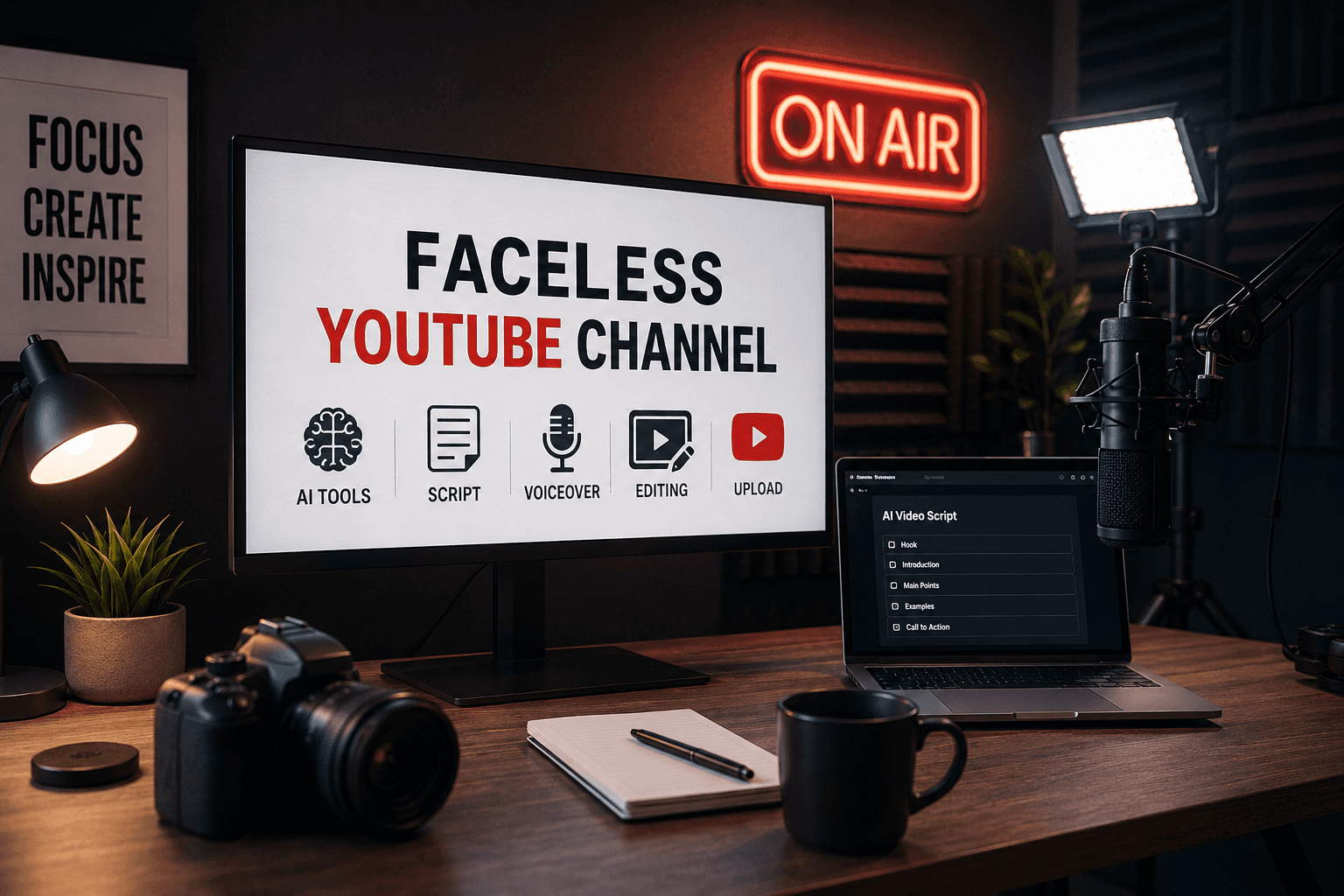
Separating the process into discrete stages is what makes the difference. When research, scripting, and production run in parallel, nothing gets finished. When they run in sequence, everything compounds.
Minute 0-5: Lock the Niche Before Anything Else
The first five minutes are not about creativity. They are about constraint.
- Pick the niche
- Define the audience
- Set the content goal
- Commit to a format
That sequence matters because every decision you make after this one depends on it. A channel without a fixed direction publishes inconsistently. An inconsistent channel confuses both the algorithm and the audience. The fix is not better content. The fix is a clearer starting point.
Minutes 5-10: Build a Content Library, Not a Single Video
Most creators who abandon their channels do so after the third upload. Not because they ran out of effort, but because they ran out of ideas. Planning 10 video ideas before recording the first one completely changes that dynamic. Three content angles and one publishing schedule, built within this window, give you something more valuable than inspiration. They give you a system that keeps running even when motivation disappears. A creator with a content library does not restart after every upload. They execute.
Minutes 10-15: Write the Script Around One Problem
Strong faceless YouTube scripts are not comprehensive. They are focused.
- One problem
- One solution
- ne clear throughline from hook to conclusion
The hook carries more weight than most creators realize. Viewers decide within the first few seconds whether to stay. A script that buries the core idea under two minutes of setup loses that decision before it ever gets made. Write the hook first, then build backward.
Minutes 15-20: Match Every Asset to the Script
The failure point in most faceless video production is asset mismatch. Visuals that do not support the narration, captions that lag behind the audio, and footage chosen before the script was finished. Each of those gaps slows production and weakens the final result.
The solution is sequential, not simultaneous.
- Finish the script
- Then build the voiceover
- Then select visuals that match what the voiceover says
That order removes the back-and-forth that turns a 20-minute task into a two-hour one.
Eliminating Production Friction
Most creators at this stage still manage voiceovers, subtitle styles, and visual assets across three or four separate tools, which means every video requires rebuilding the same production sequence from scratch. Crayo consolidates those layers into a single web-based workflow, so AI voiceovers, subtitles, and background visuals are generated together rather than assembled separately, cutting the kind of production friction that quietly kills publishing consistency.
According to Mixcord, AI voiceovers alone can reduce production time by 80%. That is not a marginal improvement. It is the difference between publishing once a week and publishing four times a week on the same effort budget.
Minutes 20-25: Publish Before It Is Perfect
Finished content generates data. Unfinished content generates nothing. The title, thumbnail, and description matter, but they matter less than the act of publishing itself. A common pattern among creators who plateau early is spending the final stage improving details that viewers never register.
- Thumbnail font size.
- Background color variations.
- Intro music levels.
Those decisions feel productive, but they delay the one thing that actually moves the channel forward: a live video with real watch-time data attached.
Minutes 25-30: Plan the Next Video Before Closing the Tab
The creators who publish consistently share one habit.
- They do not treat each upload as a finished project.
- They treat it as the first step in the next one.
Reviewing content quality and scheduling the next video in the same session removes the restart cost that accumulates between uploads. Virvid AI's 2026 breakdown of the AI faceless YouTube automation stack found that a full channel launch, from niche selection to first upload, can be completed in 30 minutes using a structured AI workflow. That number only holds when each stage feeds directly into the next without overlap.
Why Sequence Beats Speed
The frustration most creators describe is not that the process is too slow. It is that the process keeps restarting. Every new video feels like the first one because there is no system connecting them. Separating niche selection, content planning, scripting, asset creation, and publishing into independent stages removes that restart cost. Not by compressing time, but by eliminating the decisions that were never meant to be made during production in the first place. The workflow does not make you faster. It makes you consistent, and consistency is what the algorithm rewards. What that consistency unlocks at scale is the part most creators never reach, and it changes the entire economics of running a faceless channel.
Start Your Faceless YouTube Channel Faster With Crayo
Reaching the economics of a scalable faceless channel is not about working harder inside a broken process. It is about removing the rebuild cycle entirely, so every video you produce feeds the next one instead of resetting the clock. That separation is what turns a single niche into a content library and a content library into a channel the algorithm can actually reward. Most creators handle scripting, voiceover selection, subtitle styling, and visual assembly as four separate problems, each solved four times per video. Crayo collapses those stages into one session, generating scripts, AI voiceovers, and subtitle-ready assets without requiring you to switch tools or restart your thinking mid-production.
Prioritizing Execution Over Research
The result is not just faster output. It is a workflow you can repeat without friction, which is the only kind worth building.
- Pick one niche
- Open Crayo
- Publish one video before you plan the second
That single completed asset will teach you more about your channel than another week of research ever could.
Related Reading
- Faceless Instagram Content Ideas
- Best AI Generated Voice
- Best Faceless Tiktok Niches
- Best AI Tools for Social Media Content Creation
- AI Tools for Instagram Content Creation
- Best AI Dubbing Software
- Dubbing AI
- Voice Over App